If your electric scooter never reaches its advertised range, you’re not alone.
In fact, most riders don’t even come close.
Manufacturers often list impressive numbers like 40 or 50 miles of range — but in real-world conditions, the actual distance is usually much lower.
In this guide, you’ll learn:
- What “claimed range” actually means
- Why is your real range lower
- And how to get more distance out of your scooter
🎥 Watch the Full Explanation
What “Claimed Range” Really Means
When a scooter brand advertises maximum range, it’s tested under ideal conditions.
That usually includes:
- Lightweight rider
- Flat terrain
- Low, constant speed
- No wind
- Moderate temperature
In other words, it’s the most efficient scenario possible.
In real life, almost nobody rides like this.
So the advertised number is best understood as a maximum under perfect conditions, not an average you should expect daily.
What Real-World Scooter Range Looks Like
For most riders, real-world range is typically:
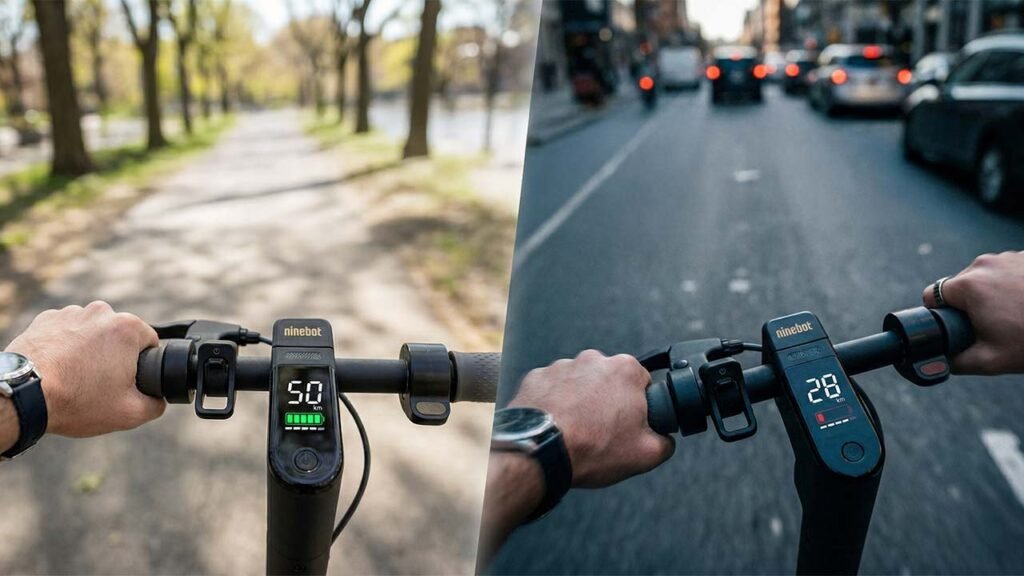
60% to 80% of the claimed range
So if your scooter is rated for 50 miles, you’ll likely get:
- Around 30 to 40 miles in normal use
- Sometimes less, depending on conditions
This isn’t a defect — it’s completely normal.
The key is understanding what affects that difference.
1. Rider Weight Has a Big Impact
Heavier riders require more energy to move.
Even a difference of 10–15 kg (20–30 lbs) can noticeably reduce range.
It’s not just body weight either.
Backpacks, groceries, or gear all add load.
More weight = more power used = less range
2. Speed Drains Battery Faster Than You Think
Speed is one of the biggest factors affecting range.
As speed increases, air resistance rises quickly — and your scooter has to work much harder to maintain that speed.
Riding at maximum speed may feel efficient, but it’s actually one of the fastest ways to drain your battery.
Riding slightly slower can significantly extend your range.
3. Hills and Terrain Matter
Flat ground is ideal for efficiency.
But most real-world riding includes:
- Hills
- Inclines
- Uneven surfaces
Climbing requires much more power than riding on flat terrain.
And you don’t fully recover that energy when going downhill.
If your route includes hills, your range will drop — sometimes significantly.
4. Temperature Affects Battery Performance
Lithium-ion batteries are sensitive to temperature.
They perform best between:
15°C to 25°C (59°F to 77°F)
When temperatures drop:
- Below 10°C → noticeable range loss
- Near 0°C → range can drop 20–40%
In hot weather:
- Range is less affected short-term
- But long-term battery wear increases
For best performance:
- Ride in moderate temperatures
- Avoid charging when the battery is very cold or very hot
Related: Electric Scooter Battery Lifespan Explained
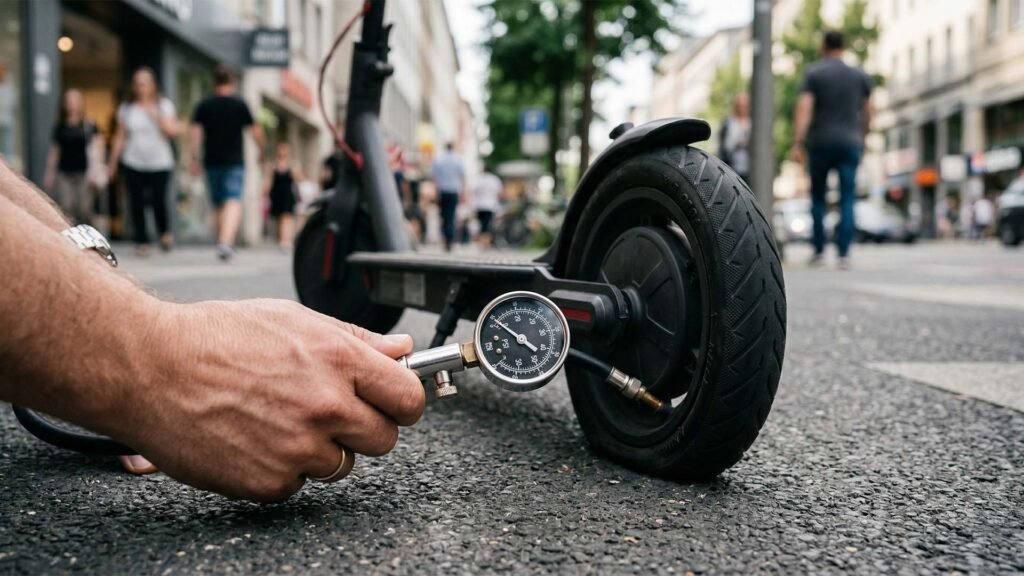
5. Tire Pressure Is an Easy Win
This is one of the most overlooked factors.
Low tire pressure increases rolling resistance, forcing the motor to work harder.
For most scooters, recommended pressure is:
40–50 PSI (2.8–3.5 bar)
(Check your specific model.)
Keeping your tires properly inflated is one of the easiest ways to improve range instantly.
Related: Importance of Tire Pressure Explained
6. Riding Style Makes a Difference
Aggressive riding reduces efficiency.
If you:
- Accelerate hard
- Brake frequently
- Ride in stop-and-go traffic
You’ll use more battery.
Smooth, steady riding helps maximize range.
How to Increase Your Electric Scooter Range
You don’t need perfect conditions to improve your range.
Small changes can make a noticeable difference:
- Ride at moderate speeds
- Keep tires properly inflated
- Avoid carrying unnecessary weight
- Accelerate smoothly
- Ride in moderate temperatures
These adjustments can add meaningful distance to every ride.
Final Thoughts
The electric scooter range isn’t fixed.
It changes depending on how you ride and the conditions around you.
The advertised number is just a reference point.
Once you understand what affects your range, you can predict it — and improve it.
And that’s what separates frustration from control.

The founder and the editor-in-chief of the Electric Wheelers blog. With a previous background in IT, sales, and video editing, he has now established himself as a micromobility expert.
He bought his first e-scooter over 5 years ago and since then has owned dozens of e-scooters and e-bikes. His deep understanding of the technical aspects, coupled with a keen eye for market trends, enables him to provide insightful and reliable content.
His commitment to promoting sustainable and efficient urban mobility solutions has made him a respected voice in the community of eco-friendly transportation enthusiasts.