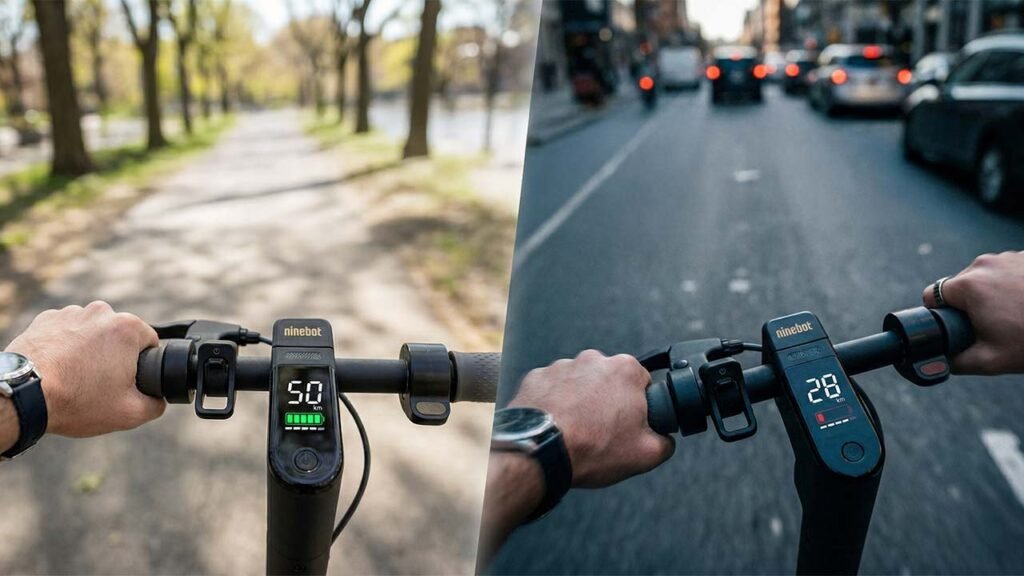
The advertised range on most electric scooters is optimistic. If your scooter claims 25 miles but you’re routinely getting 16 or 17, you’re not doing anything wrong — that gap is nearly universal.
Manufacturers test under ideal, controlled conditions: flat ground, light rider, perfect temperature, moderate speed. Real-world electric scooter range rarely matches any of those.
The good news is that a meaningful part of that gap is recoverable.
Not through expensive upgrades or hardware modifications, but through a handful of habits and adjustments that are completely within your control.
Some riders figure these out naturally. Others never realize they’re leaving miles on the table every single ride.
This post covers five methods that genuinely move the needle — plus a quick bonus tip that explains why your scooter seems to lose range every winter. Nothing here requires technical knowledge or much money.
Prefer to watch? Here’s the full video:
Why Your Scooter Doesn’t Go as Far as Advertised
Before getting into the fixes, it helps to understand what’s actually eating your range.
Every time your motor works harder than it needs to — fighting rolling resistance, powering sudden acceleration bursts, or hauling extra weight uphill — it pulls more energy from the battery than a steady, optimized ride would.
The range on the box assumes almost none of that is happening. In practice, all of it is. That’s the gap — and it’s largely controllable.
Method 1: Check Your Tire Pressure
This is the simplest fix on the list, and consistently the most overlooked.
Low tire pressure creates rolling resistance. More resistance means the motor has to work harder just to keep you moving at the same speed — which drains the battery faster. Even tires that look fine to the eye can be meaningfully underinflated.
What to do: Check your tire pressure regularly and keep it within the range specified in your scooter’s manual. Most pneumatic e-scooter tires run somewhere between 40–65 PSI, but it varies by model — check yours specifically.
A basic tire pressure gauge is all you need. They cost a few dollars and take ten seconds to use.
The mistake most riders make: Only checking pressure when the tire looks visibly flat. By that point, you’ve been riding with reduced efficiency for weeks.
Method 2: Change How You Accelerate
Riding slower helps, but it’s not the whole story. How you accelerate matters just as much as how fast you go.
Every hard burst from a standstill pulls a spike of power from your battery — far more than the same speed reached gradually. In stop-and-go riding, those spikes add up fast. Smooth, gradual throttle input uses significantly less energy to cover the same distance.
What to do: Accelerate gently from stops and aim to hold a steady speed rather than constantly surging and backing off. You don’t need to ride like you’re in a school zone — just ease into speed instead of grabbing for it.
As a side benefit, smooth riding is easier on your brakes and motor as well.
The mistake most riders make: Aggressive throttle input in urban riding, especially at traffic lights. That pattern of repeated hard acceleration is one of the fastest ways to halve your effective range.
Method 3: Reduce What You’re Carrying
Weight has a direct relationship with energy use. The heavier the total load — rider, cargo, accessories — the harder the motor works, especially during acceleration and on any kind of incline.
This doesn’t mean you need to obsess over every kilogram. But it does mean that a heavy backpack, unnecessary gear bolted to the deck, or overpacked panniers all carry a real range cost.
What to do: For longer rides where range matters, carry only what you need. Lightweight commuting bags make a genuine difference compared to a loaded hiking pack.
The mistake most riders make: Treating the scooter’s rated range as a flat number rather than understanding it changes with load. A scooter that does 20 miles solo may do noticeably less with a full bag and a heavy rider.
Method 4: Pick More Efficient Routes
Distance and energy consumption aren’t the same thing. A shorter route with hills and frequent stops can easily use more battery than a slightly longer flat route with consistent flow.
Hills are the big one. Climbing requires the motor to work significantly harder, and regenerative braking (if your scooter has it) only recovers a fraction of that energy on the descent. Rough pavement, gravel, and heavily potholed roads add rolling resistance on top of that.
What to do: When you have a choice, favor routes that are flatter, smoother, and have fewer forced stops. On a regular commute, this might mean testing two or three routes over a week and seeing which one leaves more battery at the end.
The mistake most riders make: Always defaulting to the shortest route. Shortest distance and lowest battery use are different optimization targets — they don’t always point the same direction.
Method 5: Look After Your Battery
The previous four methods help you on every ride. This one affects how much range your scooter has in six months or two years from now.
Lithium batteries degrade over time, but how fast they degrade depends heavily on how they’re treated. Three habits have the most impact:
- Avoid regular full discharges. Running your battery to 0% repeatedly accelerates capacity loss. Try to plug in before it gets that low.
- Don’t store it at 100% long-term. Keeping a lithium battery at full charge for days at a time stresses the cells. If you’re not riding for a week or more, charging to around 80% is better for long-term health.
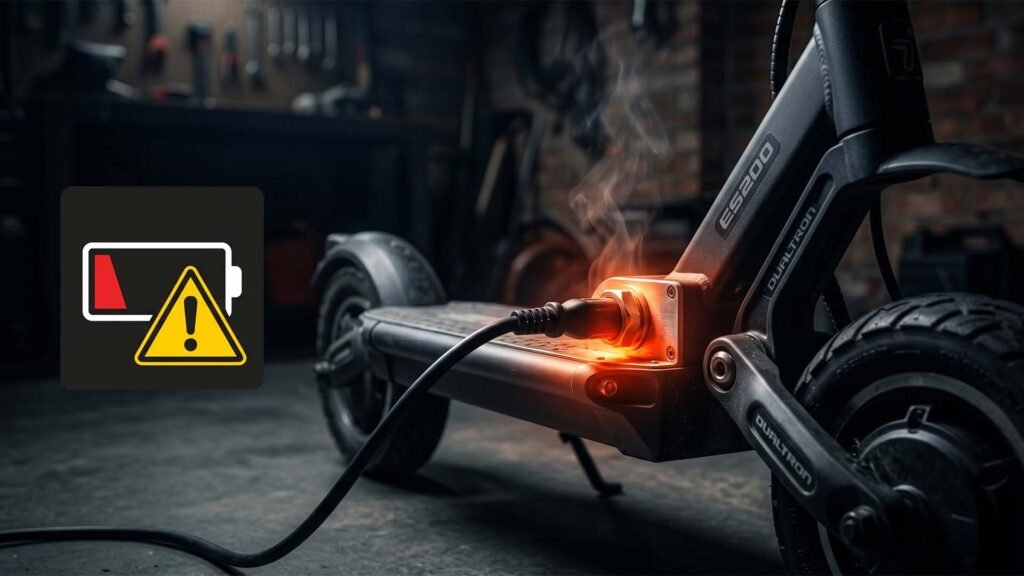
- Keep it out of temperature extremes. Heat degrades battery chemistry faster; freezing temperatures temporarily reduce performance. Store your scooter somewhere moderate when possible.
The mistake most riders make: Treating the battery as a sealed, maintenance-free component — until the range suddenly drops off a cliff a year in.
Bonus: Cold Weather Reduces Range — and There’s Not Much You Can Do About It
If your scooter’s range seems noticeably worse in winter, it’s not your imagination and it’s not a fault. Lithium batteries are simply less efficient at low temperatures.
The chemical reactions inside the cells slow down, reducing both peak power and total capacity.
The effect can be significant — some riders see 20–30% range reduction on cold days.
There’s no real workaround beyond keeping the battery warm before you ride (storing it indoors rather than in a cold garage helps). Mostly it’s worth knowing this is normal, so you’re not chasing a problem that doesn’t exist.
The Takeaway
If you want to make the biggest immediate difference, start with these three:
- Keep your tires properly inflated — it’s free and takes ten seconds.
- Smooth out your acceleration — especially in stop-and-go riding.
- Reduce unnecessary weight on longer trips.
Battery care and route optimization compound those gains over time. None of this is complicated — it’s mostly about being intentional with small habits that most riders never think about.
The better you manage these, the more distance you get out of every charge.

The founder of Electric Wheelers and the creator behind its YouTube channel.
He has spent the past 5+ years riding, testing, and figuring out electric scooters and e-bikes in real-world conditions — not just reading spec sheets.
Instead of chasing trends, he focuses on practical questions:
What actually works? What breaks? And what is worth your money?
Most of the content is based on personal experience, with the goal of helping others avoid mistakes and make better decisions.